Camera
𝐋𝐚𝐜𝐮𝐧𝐚 | 𝑱𝒆𝒐𝒏 𝑱𝒖𝒏𝒈𝒌𝒐𝒐𝒌The Camera functions in the novel as both a device for making images and a means of organizing experience. It gives Shelby Anderson a way to look outward when her thoughts remain caught in painful memories, and it later becomes part of the artistic collaboration that draws her closer to Jungkook Jeon. Through the Camera, routine places and emotionally charged relationships are converted into material that can be selected, shaped, and shown to others.
Definition and Place in the Story
The Camera is Shelby Anderson’s photographic tool, kept among the objects associated with her creative life. When she sees it resting on the living-room table, it is not merely stored equipment: it becomes an available alternative to the journey she cannot make. Shelby decides that, if she cannot go to Los Angeles, she will work with what she has, and the Camera immediately changes her from someone stalled by disappointment into someone capable of producing new material.
Its importance lies in the access it provides. The Camera does not remove Shelby’s distress or resolve the events surrounding Jungkook Jeon, but it gives those feelings a form of disciplined activity. Instead of remaining entirely inside recollection, she turns toward a sequence of concrete subjects and makes choices about framing, selection, and revision.
Shelby Anderson’s Independent Use
Shelby first uses the Camera outside the house with Loki, her German Shepherd. She takes a series of photographs of the dog and smiles at the results, finding immediate satisfaction in what she has produced. She then photographs the central elements of her everyday activities: drawing, skateboarding, walks in the forest, and reading. The range of subjects makes the resulting portfolio a record of her actual surroundings rather than a substitute fantasy for Los Angeles.
After shooting, Shelby returns to her room, sorts the photographs, makes retouches, creates a folder, and transfers it to one of her USB drives. The Camera therefore initiates a complete creative process rather than a single moment of distraction. Taking images is followed by editing, preservation, and preparation for possible use. The device participates in Shelby’s recovery by helping her impose sequence and purpose on experiences that otherwise return to her in an uncontrolled loop.
This work also stands against the emotional confusion created by Jungkook’s contradictory behavior. Shelby continues to think about their kisses, his sudden cruelty while intoxicated, his solemn apology, his account of his violent father, and the distressing night in hospital. The Camera does not erase those memories, but it gives her another activity through which she can act rather than merely react. Its usefulness is practical, yet its effect is psychological: it helps her recover a measure of attention and agency.
Landscape, Perception, and Artistic Method
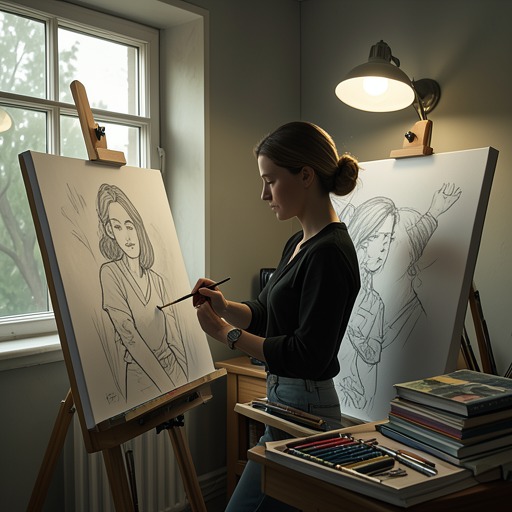
Shelby’s relation to the Camera is connected to her broader habit of observing places closely. At Ellensburg Forest, she works with a sketchbook and pencil on the lakeside pier, studying the lake and trees until the scene is fixed in her mind and translated onto paper. The Camera extends this same attentiveness into photography. Drawing and photographing are presented as related practices: both require Shelby to select details from the world and convert perception into an intentional composition.
The forest scene also places Shelby and Jungkook in the same creative environment. While Shelby draws and listens to The Mamas & The Papas song "Dream A Little Dream Of Me," Jungkook listens to nature and to her voice while continuing his own drawing. Their simultaneous, quiet work shows that artistic perception can create proximity before either character is ready to speak openly. The Camera belongs to this wider network of creative practices through which Shelby and Jungkook begin to recognize one another beyond their defensive behavior.
Shelby’s drawing later receives a teacher’s close reading. The instructor praises the identifiable landscape and the sense of nature’s benefits but detects melancholy within it, arguing that an artist cannot fully conceal emotion. Although this particular work is a drawing, the observation clarifies the Camera’s larger narrative function: Shelby’s creative output repeatedly reveals feelings that she does not explain directly. Images become evidence of her inner condition, carrying sadness even when the chosen subject appears peaceful.
Transition to Shared Photographic Work
The Camera also prepares the ground for the semester’s final photography assignment. The students are asked to make black-and-white photographs on any subject, with strong contrasts and an important interplay of shadow and light. Shelby finds the project uninspiring, and Jungkook initially shares her lack of enthusiasm. Yet as he looks at Shelby, ideas begin to emerge; he sees her as photogenic and recognizes artistic potential that can be explored.
This moment shifts the Camera’s meaning from private instrument to possible relational medium. Photography can become a way for Jungkook to engage Shelby through an artistic task rather than through confrontation or unstable intimacy. The assignment’s emphasis on contrast and shadow also suits the emotional structure surrounding them, though the evidence grounds that significance in the concrete requirements of the project rather than in a literal claim that the device possesses intention.
Narrative Significance
The Camera’s decisive role is to make visible what Shelby struggles to articulate. It records Loki, drawing, skateboarding, forest walks, and reading, but the resulting collection also records a period in which she is attempting to remain active while carrying depression, anxiety, and painful memories. Its images are therefore both documents of ordinary life and traces of emotional survival.
As a material object, the Camera is most powerful when it remains ordinary and usable. It is picked up from a table, carried outside, used repeatedly, and supplemented by editing and storage on a USB drive. That sequence gives Shelby a tangible route from blocked desire to creative action. Later, within the black-and-white project that links her to Jungkook, the same device helps turn observation into collaboration. Its lasting significance is not that it cures either character, but that it creates a structure in which attention, craft, and shared artistic purpose can begin to replace paralysis and isolation.